
Hilti offers concrete fastening solutions assessed under European standards and approvals for design working life up to 120 years. This article explains the relevant framework and how selected Hilti solutions can support such designs.
1. A BACKGROUND TO DURABILITY & SERVICE LIFE OF REINFORCED CONCRETE STRUCTURES
The earliest concepts of service life for buildings and structures go back to when builders first observed that certain materials and design approaches performed better than others. For much of history, estimating the specific service life of structures, equipment and individual components was largely empirical and qualitative in nature [1]. With the advent and subsequent introduction of reinforced (RC) concrete in the construction industry in the latter 1800s, the durability of reinforced concrete structures – particularly the corrosion of reinforcing steel – became a key topic. This triggered systematic investigations into how to avoid loss of durability over a given time period.
The “durability” of structural concrete relates to its ability to withstand the design environment over a specified time without undue loss of serviceability and without the need for major repair. For example, a concrete structure that performs satisfactorily in a dry environment may deteriorate significantly faster in a coastal environment with chloride exposure.
The “design working (or service) life” is a specific period after placement of the concrete, or installation of equipment to concrete, during which the structure or component is intended to maintain the required performance characteristics under both the anticipated exposure conditions and with routine maintenance. Designing structural concrete for a given design working life therefore involves:
- Architectural and structural designs,
- Selection and design of the material components,
- Maintenance planning, and
- Quality assurance and quality control plans [2].
Modern limit-state design standards, such as EN 1990:2023 [3], typically use a reference design working life of 50 years for common buildings and structures. Longer design working lives (for example 100 or 120 years) are generally associated with critical infrastructure where demolition and reconstruction would be extremely difficult or costly, such as major bridges, tunnels or nuclear containment structures. In many countries, infrastructure owners and public authorities increasingly request extended design working lives beyond 50 years. Structural engineers are therefore often asked to provide designs for:
- Changing exposure environments from short-term extreme weather events to long-term climate change,
- Introduction of new construction materials aimed at reducing environmental impact,
- Limitations of existing knowledge and in models for service life prediction,
- A clear definition of “end of service life” in practical terms,
- Inconsistent construction quality on site,
- The practical impossibility of fully verifying the structural design for a structure intended to last for 100- or 120-years [4].
2. DESIGN WORKING LIFE REQUIREMENTS FOR STRUCTURES AND VARIOUS TYPES OF FASTENINGS & CONNECTIONS TO CONCRETE UNDER THE EUROPEAN FRAMEWORK
Durability does not explicitly translate into design working life in the form of an equation. Under the framework of the Eurocodes, EN 1990 provides indicative guidance that designers may consider when estimating deterioration based on calculations, experimental investigations, prior experience or a combination of these. The link to a design working life is established in EN 1990, Section 4, which specifically requires, among others:
1. The identification of exposure classes,
2. The specification of concrete and detailing for a particular design working life, and
3. The verification that the structure will remain functional and safe with standard maintenance over its intended working life.
In EN 1990 [3], durability is also linked to the reliability of structural performance, which depends on time and deterioration for a given service life. Reliability is ensured by applying the fundamental principles for durability, safety, and serviceability together with a limit- state approach based on partial factor methods. Reliability is expressed, among other indicators, through the “Target Reliability Index (β)”, which may increase for longer design working lives (reflecting both the consequence and probability of failure). This influences design actions by modifying the partial safety factors for both loads and resistances.
Reliability considerations are embedded in all four parts of EN 1992. Design working life is addressed primarily through Serviceability Limit State (SLS) design requirements, which often become critical when the design working life of a structure is 100 years or more, as durability-related failures frequently precede strength-related failures, which are covered by Ultimate Limit State (ULS) requirements.
A typical scenario for extended design working life could be a road tunnel designed for 100 or 120 years. The design team may evaluate whether key components, such as jet fans for smoke and exhaust ventilation connected to the concrete tunnel lining using post-installed fastenings, can be designed reliably for the same period. For example:
- Does the fastening of a jet fan to the concrete tunnel lining need to provide resistance for the full 120 years, even if the fan itself is replaced after 30 years?
- Can the fastenings be designed to sustain the relevant actions for the full design working life without unexpected degradation in performance?
In such cases, the overall design philosophy is often to replace the fixture (fan) while retaining the fastening system. Re-drilling and replacing of new post-installed fasteners can be more time-consuming and may risk damaging the reinforcement within the tunnel lining. In such a setup, designers may choose a fastener to be:
- Suitably qualified for an *assumed design working life up to 120 years, as stated in the related ETA, and
- Designed using provisions that are appropriate for the same design working life.
*Note: in the ETAs, the term “design” working life is replaced by “assumed” working life to distinguish between the (assumed) working life of the fastening or connections in concrete and the (design) working life of concrete member to which it is attached. In certain scenarios, both working lives may coincide.
2.1. Post-installed fastenings in concrete
For post-installed fastenings of steel baseplates to concrete using suitably qualified bonded or mechanical anchors and designed according to the Ultimate Limit State, EN 1992-4, the reliability class and design working life are defined in Clauses 4.1 (2) and (3) as RC2 with β = 3.8 for a 50-year reference period (see EN 1990 [3] for more information concerning Consequence Classes). The recently adopted EOTA Technical Report TR 086 extends the EN 1992-4 [5] design provisions to allow design for a design working life of up to 120 years, provided that:
• The chosen fastener is assessed accordingly (for example through an ETA referring to a 100- or 120-year working life), and
• The design is carried out strictly in accordance with EN 1992-4 and TR 086 as applicable, including all conditions and limitations stated in the ETA.
2.2. Post-installed rebar connections with mortar
Similarly, post-installed rebar connections with suitably qualified mortars can be designed as equivalent to cast-in rebars for a service life of up to 50 years with the same target reliability index β = 3.8, using the provisions of EN 1992-1-1. EOTA Technical Report TR 086 extends the EN 1992-1-1 design provisions for post-installed rebars to design working lives of up to 120 years, provided that the relevant systems are assessed and used within the conditions defined in the corresponding EADs and ETAs.
3. ASSESSMENT OF POST-INSTALLED FASTENINGS AND CONNECTIONS IN CONCRETE ACCORDING TO THE EADs FOR SERVICE LIVES BEYOND 50 YEARS
As with the structure itself, the performance of individual components such as post-installed bonded and mechanical fasteners, is influenced by several interacting factors. Reliable performance over the intended design working life of the structure requires assessment within a standardized framework.
For post-installed bonded and mechanical fasteners, as well as mortars used in post-installed rebar (PIR) connections, the European Assessment Documents (EADs) provide this framework. For extended design working lives of a fastener or PIR, the assessment concept of the EADs distinguish between:
- Tests that are primarily time- or cycle-dependent, and
- Tests that are largely independent of time or number of cycles.
These assessments are reflected in the ETA and form the basis for design in line with the cited EAD and relevant European provisions.
3.1. EAD 330232 for Mechanical fasteners
For mechanical anchors assessed to EAD 330232 [6], the main time- and cycle-dependent tests are:
- Crack cycling under load – assesses the anchor’s performance under long-term loading in cracked concrete. Cracks are opened to 0.3 mm and closed repetitively for 1000 cycles for 50-years’ design working life, 2000 cycles for 100 years, and 2400 cycles for 120 years.
- Repeated loads – assesses performance under repetitive, yet varying service loads throughout the design working life: for a 50-year design working life, the anchor is subjected to 100,000 load cycles; 200,000 cycles for 100-years; and 240,000 cycles for 120-years.
- Durability in relation to corrosion, coating, and jamming – certain anchor types (such as expansion anchors), rely on the expansion of their cones relative to the sleeve; here, unobstructed movement of the cone against the sleeve is essential to prevent a loss of functionality. Although not linked to a specific design working life, selection of the right material (such as stainless steel) and coating compositions support the assessment of suitability for extended working life considerations (e.g., up to 120 years) within the ETA framework.
3.2. EAD 330499 for Bonded fasteners
For bonded fasteners used in post-installed fastenings and connections to concrete, the long-term performance is strongly influenced by creep behavior of the chemical mortar. This behavior differs from that of concrete with reinforcing steel. To assess the long-term performance of the chemical mortar, EAD 330499 [7] therefore includes the following time- and cycle-dependent tests:
• Sustained load – assesses the (long-term) creep behavior of the loaded fastener at ambient temperature and at the maximum long-term service temperature. For a 50-year design working life, tests run for at least three months, primarily focused on not exceeding a critical displacement limit. For extended working lives of 100 and 120 years, the mortar is subjected to sustained loads for 6 and ~7.5 months.
• Repeated loads – assesses performance under repeated load cycles, similar in principle to the approach for mechanical fasteners.
• Crack cycling under load – similar to mechanical fasteners, with but additional focus on limits on displacement.
• Additional tests for durability – the bond of certain chemical mortars may be sensitive to aggressive environments containing high sulfur or high alkalinity. The EAD requires assessment of their performance under such environmental conditions. Combined with appropriate material composition, this supports the declaration of an anchors working life of up to 120 years for the specified exposure conditions.
• Additional tests for freeze-thaw – indirectly linked to design working life, these tests evaluate the anchor’s performance when installed and cured under freezing conditions.
3.3. EAD 330087 for post-installed rebar connections equivalent to cast-in
As with bonded fasteners, chemical mortars used for post-installed rebar connections are subject to a similar assessment for extended design working lives. The key relevant time- / cycle-dependent test is:
• Sustained load – similar to bonded anchors at ambient and maximum long-term temperatures, but with lower loading requirements considering that post-installed rebar systems have higher redundancy.
• All other tests largely follow the methodology of EAD 330499 [8].
3.4. EAD 332402 for post-installed rebar connections with improved bond-splitting behavior
For post-installed rebar connections with improved bond-splitting behavior, many time- / cycle-dependent tests are aligned with the test concepts of EAD 330499 and EAD 330232 for extended design working lives. EAD 332402 [9] specifically addresses rigid end anchorage situations. At the time of writing, EAD 332402 does not yet explicitly cover a 120-year design working life. Where a 120-year design working life is required for such applications, this is typically addressed by:
• Independent third-party evaluations and/or,
• Project-specific or system-specific technical documentation (e. g. Hilti Technical Notes),
subject to the acceptance of the relevant approval bodies and authorities. Designers must verify, on a project- and country-specific basis, which documents and working lives are recognized by the applicable authorities
4. HILTI SOLUTIONS FOR FASTENINGS REQUIRING EXTENDED WORKING LIFE
Hilti offers a range of mechanical anchors and bonded systems that are assessed for extended design working lives of 100 and/or 120 years under the European framework, when designed and installed in accordance with the relevant ETAs, EADs, Eurocodes and Hilti Instruction for Use.
Table 1 provides an overview of selected anchor solutions for post-installed steel-to-concrete fastenings with extended design working lives:

Table 1: Anchor solutions for post-installed steel-to-concrete fastenings for an extended design working life of 100 & 120 years
Designers must consult the current versions of the ETAs to confirm the permitted design working life, exposure conditions, installation parameters and limitations for each product.
Table 2 includes selected post-installed rebar systems with chemical mortars assessed for equivalence to cast-in rebars for an extended design working life:
Table 2: Solutions for post-installed rebar connections equivalent to cast-in rebars for an extended design working life of 100 & 120 years
Designers should note that when designing post-installed reinforcement equivalent to cast-in rebars, the required anchorage length calculated from the design bond strength depends strongly on the nominal concrete cover (cnom), which includes the minimum concrete cover (cmin) based on exposure classes according to EN 1992-1-1.
Table 3 highlights post-installed rebar systems with improved bond-splitting behavior for rigid end anchorages with an extended design working life:
Table 3: Solutions for post-installed rebar connections with improved bond-splitting behavior for 100 & 120 years
For all systems, the design working life stated in the ETA or related technical documentation does not constitute a guarantee of actual service life for any specific application. It is a design parameter based on standardized tests and assumptions defined in the EAD and ETA. Actual performance depends on design, installation, environmental exposure and maintenance.
5. DESIGN FLEXIBILITY IN YOUR HANDS – LEVERAGE THE POWER OF PROFIS ENGINEERING
Hilti’s cloud-based design software Profis Engineering introduces new options to support designers in selecting and designing post- installed fastenings and connections in concrete in accordance with European design standards and the corresponding ETAs.
Within the PROFIS Engineering Concrete module, users can select extended design working lives (for example 100 or 120 years) for post-installed fastenings in concrete via a dedicated dropdown field (Figure 1). This provides a design model that is consistent with the chosen working life and the corresponding ETA for the selected fastener, as highlighted by Figure 1 for post-installed fastenings in concrete.
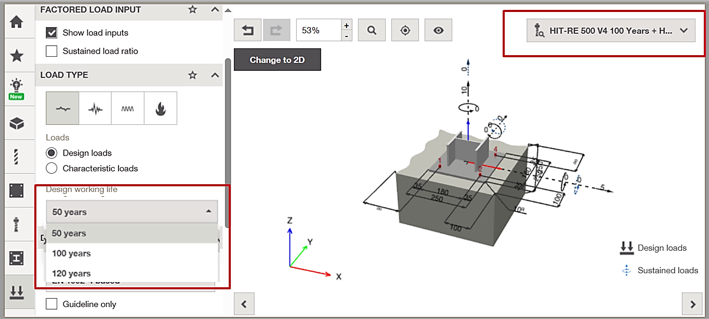
Figure 1: Dropdown selection options for extended design working life in PROFIS Engineering's Concrete module
A similar option can be found in the Post-installed Rebar module for design of rebar equivalent to cast-in rebars or with improved bond-splitting behavior,illustrated by Figure 2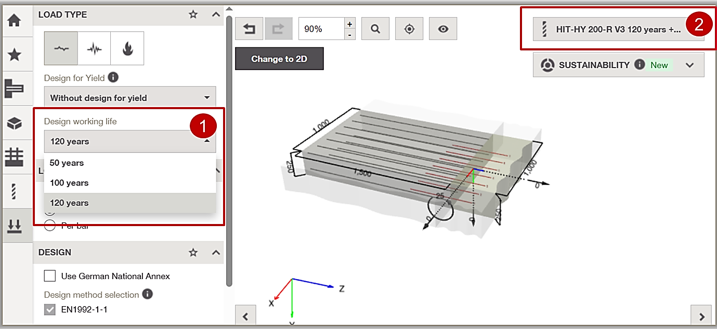
Figure 2: Dropdown selection options for extended design working life in PROFIS Engineering's Post-installed Rebar module
Design responsibility remains with the qualified structural engineer. PROFIS Engineering supports the application of ETA-based data within the design framework.
6. SUMMARY
With growing requirements arising from governments and infrastructure owners to design crucial buildings and other civil infrastructure for an extended design working life, engineers and contractors face new challenges when accounting for and resolving issues related to durability. For several reasons, certain structural and, increasingly, non-structural components in these structures require a design working life beyond 50 years. Reliably assessed according to the state-of-the-art European Assessment Documents and integrated into PROFIS Engineering, designers and contractors can work with ETA-approved Hilti solutions that support extended design working life considerations for post-installed mechanical and bonded anchors for steel-to-concrete fastenings and rebar connections.
To know more, refer to our Whitepaper that expands on this article.
To start designing, visit https://profisengineering.hilti.com/
7. REFERENCES
1. L. F. Salzman, “A History of Building Materials. By Norman Davey, O.B.E., D.Sc., F.S.A. Phoenix House, London. 1961. 260 pp., 49 plates, 134 illustrations in text. 65s.,” The Antiquaries Journal, vol. 42, no. 1, pp. 111–111, 1962.
2. American Concrete Institute, ACI 365.1R-17 - Report on Service Life Prediction. Farmington Hills, MI, USA: ACI, 2017.
3. European Committee for Standardization, Eurocode - Basis of structural and geotechnical design (EN 1990). Brussels, Belgium: CEN, 2023.
4. M. Alexander and H. Beushausen, “Durability, service life prediction, and modelling for reinforced concrete structures – review and critique,” Cement and Concrete Research, vol. 122, pp. 17–29, Aug. 2019.
5. European Committee for Standardization, Eurocode 2 – Design of Concrete Structures – Part 4: Design of fastenings for use in concrete (EN 1992-4). Brussels, Belgium: CEN, 2018.
6. EOTA, “EAD 330232-02-0601-v01: Mechanical Fasteners for use in Concrete, working life of 120 years.” Brussels: EOTA, 2019.
7. EOTA, “EAD 330499-02-0601-v02: Bonded fasteners and bonded expansion fasteners for use in concrete.” Brussels: EOTA, 2024.
8. EOTA, “EAD 330087-02-0601-v01: Variant: Systems for post-installed rebar connections with mortar - 120 years working life.” Brussels: EOTA, 2021.
9. EOTA, “EAD 332402-00-0601-v02: Post-Installed reinforcing bar (rebar) connections with improved bond-splitting behaviour.” Brussels: EOTA, 2024.
