

Learn about the latest post-installed anchor design method as per NZS 3101
All construction projects have at least one steel-to-concrete connection, whether it is a steel beam and a concrete wall, a canopy outside of a building or even balustrades.
Solutions can be cast-in or post-installed fasteners, which are often called concrete anchors. In March 2019, the European Committee for Standardization (CEN) officially published a new part of Eurocode 2 regulating safety-relevant steel-to-concrete connections (Eurocode 2 Part 4: Design of fastenings for use in concrete).
You might ask why is this relevant for connection design in New Zealand. Since amendment 3 of NZS 3101 in August 2017, chapter 17.5.5 states that:
“Post-installed mechanical anchors and post-installed adhesive anchors shall pass the prequalification testing stipulated in ETAG 001, Annex E and be designed in accordance with EOTA TR 045.”
Currently, EOTA TR 049 is the successor document for ETAG 001 Annex E and EOTA TR045 has been superseded by EN 1992-4 in early 2020.
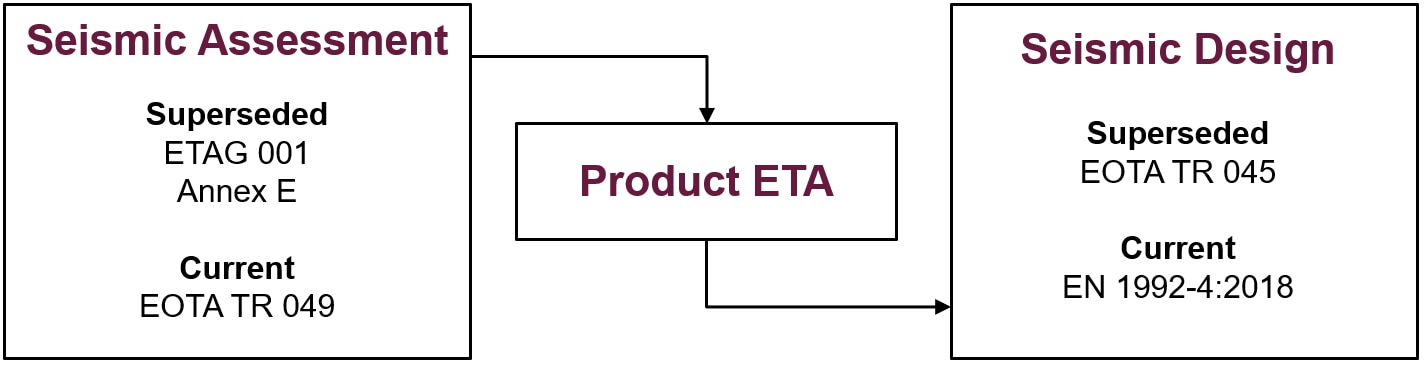
The guidelines for design and qualification for post-installed fixings into concrete under NZS 3101 Chapter 17.5.5 have been superseded by TR 049 and EN 1992-4
It’s important to note that while the overall design concept remains the same, EN 1992-4 introduces some important technical changes with regard to calculating the resistance of fastenings.
Fastener performance, meanwhile, must continue to be taken from the European Technical Assessment (ETA) document of the anchoring system in the case of anchor design, where there are no technical differences between ETAG 001 Annex E and EOTA TR 049.
Let’s go through some of the changes you will experience when switching from EOTA TR 045 to EN 1992-4.
Change 1: Shift in concrete strength evaluation from cubic to cylindrical samples
The original equations for determining concrete-related failure loads, such as concrete cone failure and concrete edge failure, were determined by considering the concrete compressive strength of concrete cubes with an edge length of 200 mm. When transferring the design concept to other fastening systems or guidelines, the corresponding equations were given with reference to a concrete compressive strength of concrete cubes with an edge length of 150 mm.
As part of the revisions made to the European standard, the equations in question were adjusted to reflect the cylindrical compressive strength (150 mm x 300 mm). Based on this adjustment, up to 4–5% lower resistance values are calculated in EN 1992-4.
Change 2: Possibility of increased concrete cone failure resistance during a bending moment
When concrete anchor fastenings are subjected to a moment of force, one side of the base plate should be working under tension whereas the other will be working under compression. EN 1992-4 considers the positive effect of the compression force acting on the concrete surface, which may increase concrete cone resistance in specific conditions. EOTA TR 045 does not take this effect into consideration.
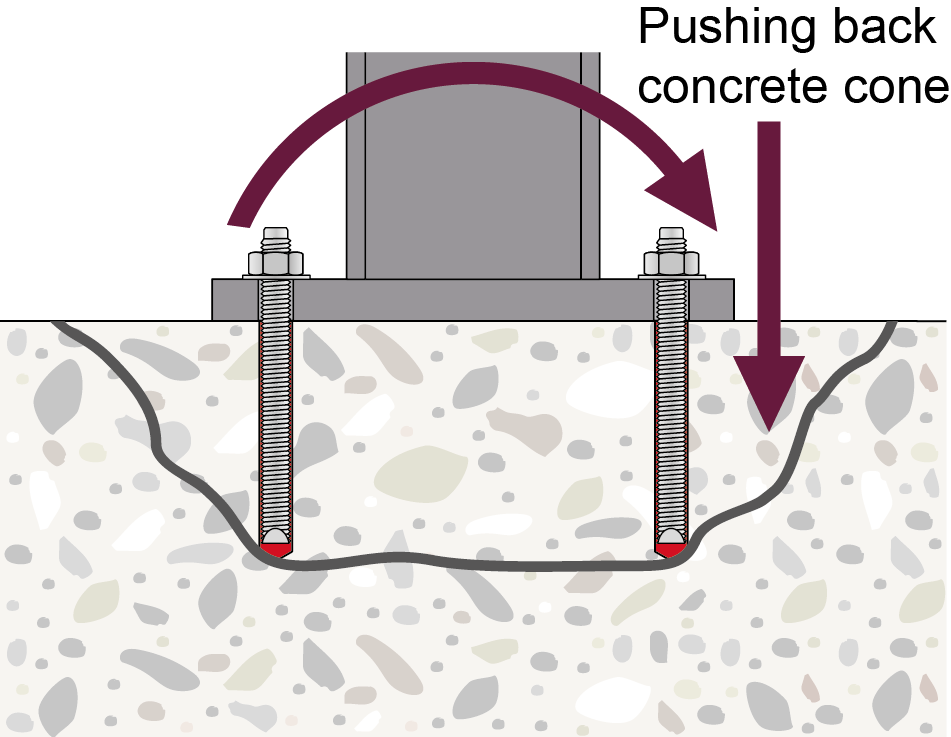
EN 1992-4 considers the positive effect of the compression force acting on the concrete
Change 3: Creep behavior of chemical anchors under permanent (sustained) loads
A new sustained load factor for chemical mortars ψsus is introduced in EN 1992-4 to take account of their potential creep behavior.
This factor depends primarily on the ratio of sustained loads to total actions: conceptually, after a certain ratio, the higher the percentage of sustained load (e.g. dead load) against total load, the higher the strength reduction.
Secondly, the product performance ψ0sus stated in the ETA document is taken into account. If no additional information regarding this factor is provided in the ETA, it is considered to be 0.6.
For example, let’s take a product whose ψ0sus is 0.8 according to its ETA. This means that if the sustained load ratio is below 80%, the resistance will not be reduced due to creep, but if the sustained load is 90%, the resistance of this failure mode will be reduced by 10% (ψ_sus = 0.9). The chart below illustrates different potential scenarios.
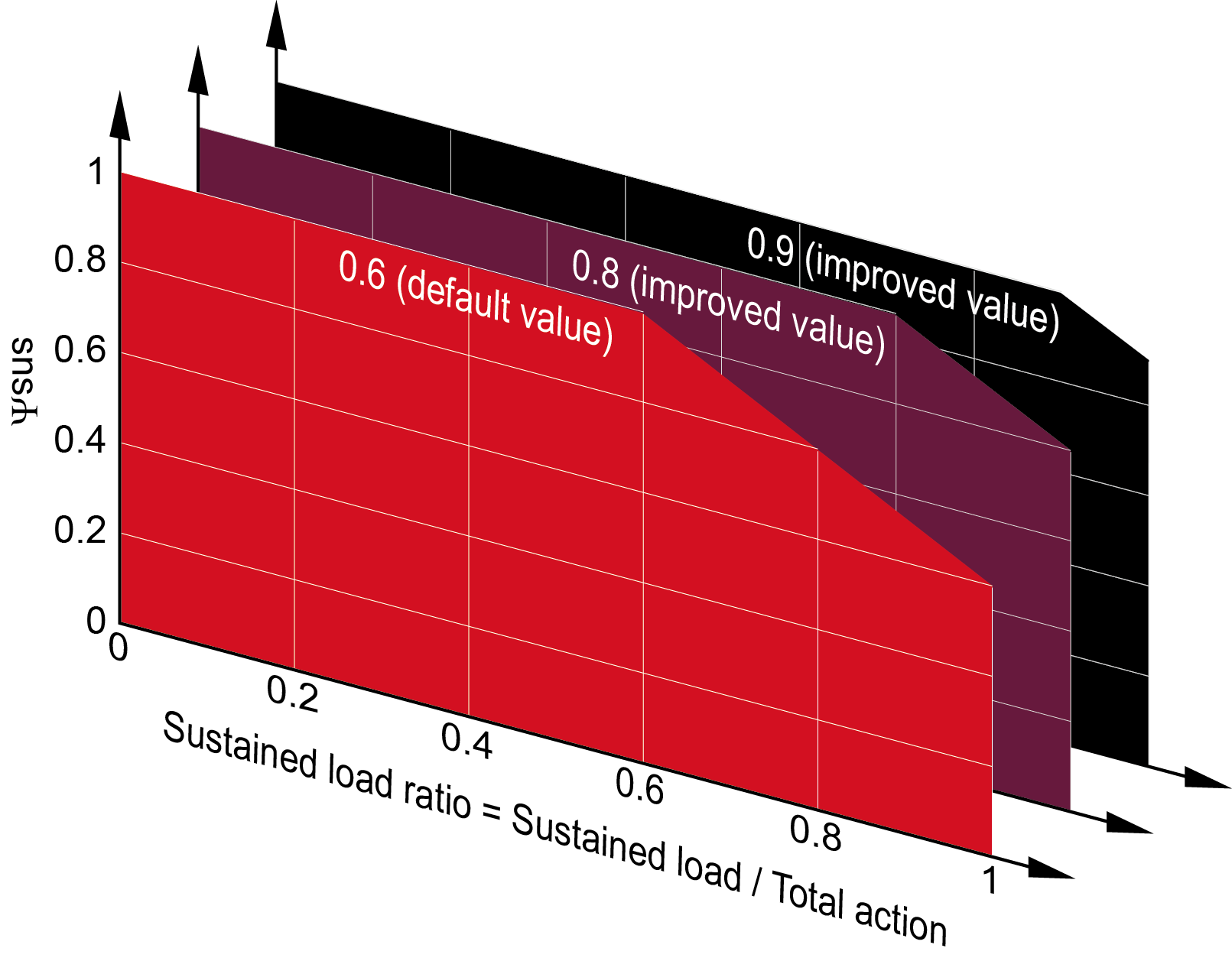
A sustained factor may be considered in the design of chemical anchor solutions in EN 1992-4.
Change 4: More flexibility to neglect splitting failure
Although the calculation method remains unchanged, there are more cases in which this failure mode can be omitted from the calculation. To neglect the verification of this failure mode, the required member thickness is reduced from 2 h_ef (EOTA TR 029 + TR 045) to h_min (as per EN 1992-4).
Change 5: Adjustment to concrete edge failure formula
There are several detailed equation changes in EN 1992-4 compared with ETAG concerning the failure mode resistance calculation, such as the effective length for edge failure, the existing rebar influencing factor and the action direction influencing factor. All of these changes can lead to the possibility of reduced resistance, but the circumstances in which these changes can occur are rare.
Change 6: Change of allowable anchor configurations
Under the guidelines of EOTA TR 045, anchor groups were limited to 1, 2 or 4 anchors in a unless certain edge distance or loading conditions were met. Although it has been possible to design with additional anchor group configurations using SOFA filled holes and the Hilti filling set, it is now written into EN 1992-4 that additional anchor configurations can be used with all edge distances and load directions provided if there is no hole clearance between the anchor rod and the baseplate.
Change 7: Separate consideration of steel and concrete for combined tension and shear failure
When the resistance of combined tension and shear failure is calculated according to EOTA TR 045, only the worst utilization under combined tension and shear load is taken into account, without considering that one may be steel failure and the other concrete. This approach is very conservative as ETAG combines two different failure types.
EN 1992-4 specifies that steel failure and concrete-relevant failure modes should be considered separately, thereby potentially delivering higher utilization values than ETAG, especially under seismic conditions.
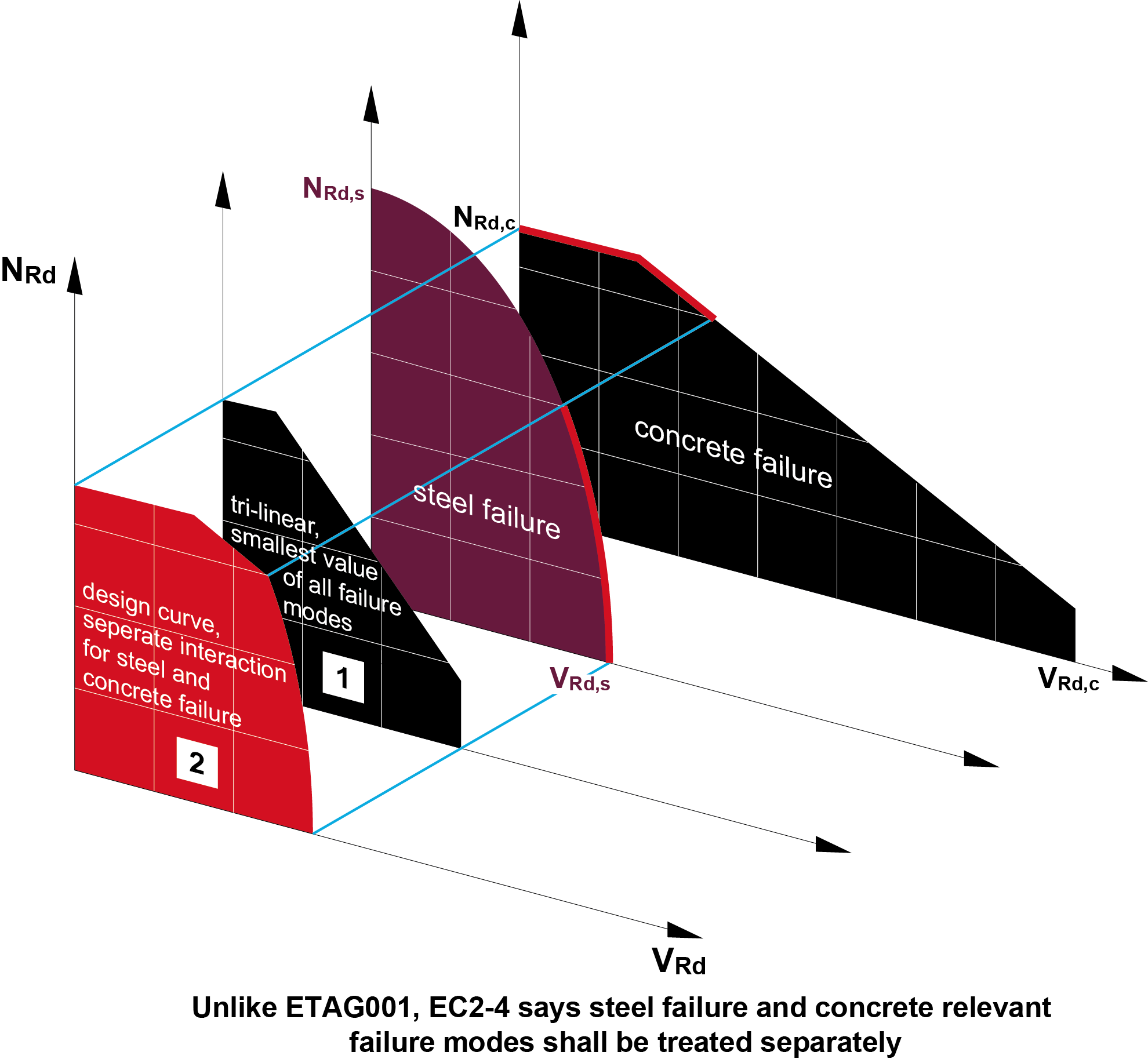
Unlike ETAG 001, EN 1992-4 treats steel failure and concrete-relevant failure modes separately.
These changes may seem daunting to begin with, so please feel free to reach out to us. Our approvals have been updated according to the new European Assessment Documents (EADs), and our PROFIS Engineering software is fully compliant with the new design standard. Don’t limit yourself to anchor design, either: PROFIS Engineering Premium is the perfect tool to design the full connection according to the latest references in NZS 3101, including the base plate, stiffeners, welding and profile, and to assess the effective rigidity of the base plate as required by anchor design provisions. Efficient and all in one place.
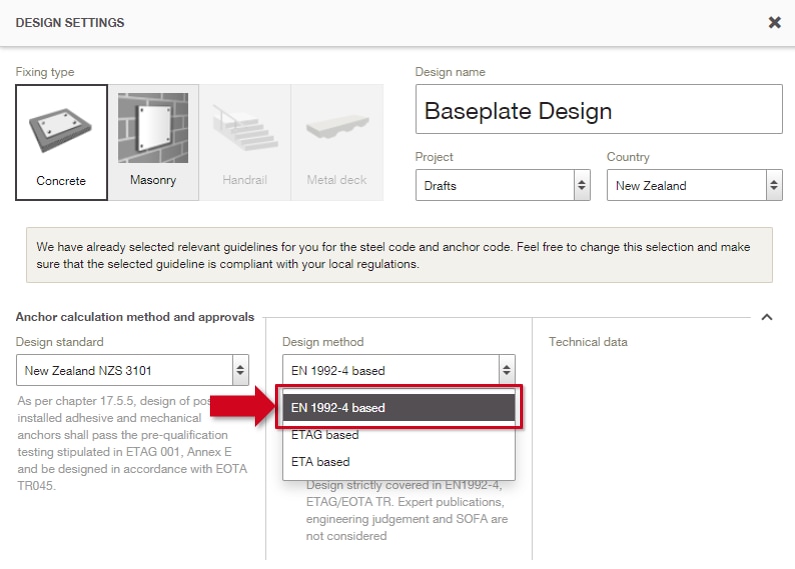
The EN 1992-4 based anchor calculation method is integrated into PROFIS Engineering.
