

M-ratings in UL certified listings
Over the lifecycle of a building, movement can occur beyond the normal rigid support of penetrants through a rated assembly, which may impact the performance of firestopping. It’s important to have a method to consider movement and its impact on firestopping. The ASTM – E 3037 Standard Test Method for Measuring Movement Capabilities of Through-Penetration Firestop Systems was issued to provide a standardized method of assessing the ability of firestop systems to experience movement and continue to be relied upon to perform their firestopping function.
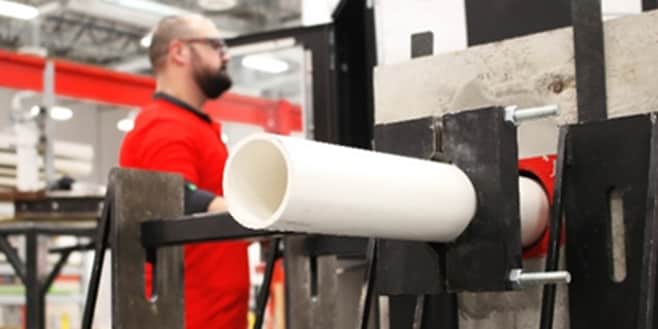
Movement test of a cast in Firestop device (picture: Hilti)
A new test standard (1)
Stopping the spread of fire is crucial to reducing the risk of injury or damage to buildings. Firestop systems, which close the openings in fire rated barriers such as interior walls or floors, created by penetrants, such as plumbing, communication or wiring, are an important elements in achieving the goal of limiting risk and damage from a fire event.
Over time, movement from seismic activity, thermal cycling, water hammer and human impact may affect the position of the penetrant and consequentially, the firestop system. When elements of construction move, either during installation or afterwards, they may adjust in such a way to pose a risk to the firestopping to sufficiently stop a fire. Without a consistent test methodology for evaluating a movement and fire condition, firestop system manufacturers were left without a clear way to demonstrate their products or systems still complied with recognized fire test standards such as UL 1479, the Standard for Fire Tests of Penetration Firestops.
The movement standard development process began with designers, engineers, architects, and contractors who understood that movement occurs during the lifecycle of a building and that movement can occur in firestop systems as a result. UL, along with several additional manufacturers, had worked as part of a team to develop ASTM E3037-16: Standard Test Method for Measuring Relative Movement Capabilities of Through-Penetration Firestop Systems, helping to evaluate the performance of firestop products and systems after exposure to cyclic movement. A new UL Certification program quantifies a firestop system’s ability to accommodate movement and still meet the fire protection requirements of the fire test UL 1479.
How can we assess the effects of movement on firestop?
UL(2) published the certification program for M-ratings with the intent of assessing the movement capability of through-penetrations, such as pipes and cables passing through rated assemblies. This lists firestop systems that designers, architects, engineers and contractors can use when there are anticipated movements of through-penetrating items. The listings identify movement capabilities based on movement direction, pipe type and diameter, annular space, and firestop sealant depth (where applicable).
Systems are tested by cycling a certain number of times at a certain distance in accordance with ASTM E3037, the standard described above. Samples are tested in two directions, the Z direction, which is parallel to the penetrant, and the Y direction, which is perpendicular to the penetrant (as shown in Figure 1). Each cycle and distance are tracked until a maximum movement capability is attained. The system is then tested to the applicable test standard, such UL 1479/ASTM E814 to ensure the firestop system will perform as intended in the event of a fire, even after being subjected to movement. Note that a system cannot be certified for movement alone and that it must also be subjected to a fire test. If the desired fire ratings are reached during the burn test, the system can be certified for an M-rating as well as a fire rating.
The criteria are documented in four movement displacement ranges, which are user friendly to the design team, for both the Z direction, parallel to the penetrant (shown in Figure 2), and the Y direction, perpendicular to the penetrant (shown in Figure 3). The movement range categories for the Y direction are (up to) 5%, 25%, 50%, and 100% of the annular space, and for the Z direction (up to) .25”, .5”, 1”, 3.21”.
How can you specify movement requirements?
In unique scenarios where movement is anticipated, it is now possible to add the movement criteria: which is an exciting new development to the industry. Like ratings for other additional attributes of firestop systems, such as air leakage (L-rating) and water resistance (W-rating), the M-rating, can also be included on the listing. With this rating, the movement criteria can be specified and, if movement occurs within the tested range, the firestop system is expected to perform as intended. An example of a listing with L, W, and M-ratings is shown below. It demonstrates the specific M-rating capabilities for the example listing.
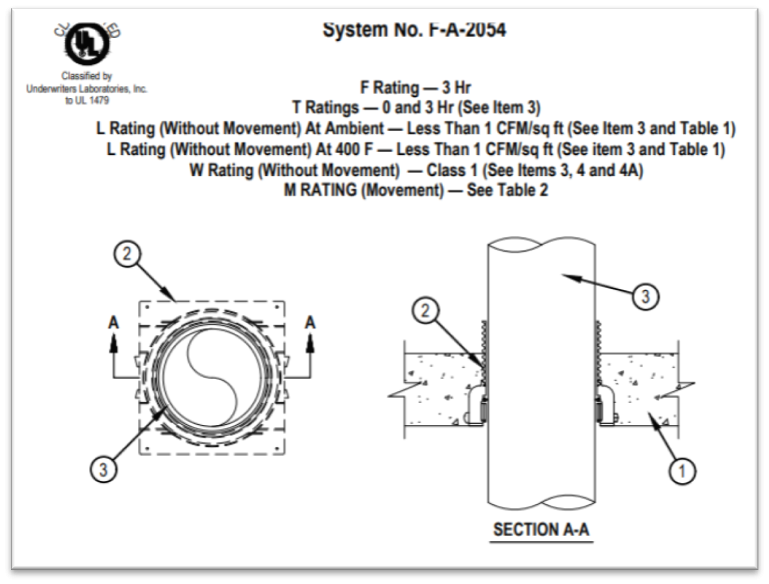
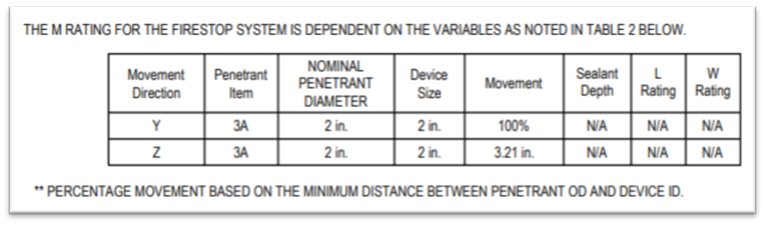
Excerpt of a Firestop system reference UL System No. F-A-2054 with Hilti Cast in Device with M rating
For systems that require movement, the designer can specify the minimum movement capabilities required, and can use this information to select a firestop solution. Within specifications, they can reference a requirement for an M-rating system that is tested to ASTM E3037. A schedule of listed systems with M-ratings can also be included on drawings and in specifications. Firestop details with M-ratings can be included on drawings. By specifying innovative firestop solutions that reduce the risk of through-penetration movement, designers can help ensure that movement is adequately accommodated within their designs.
Preferred Firestop devices accommodate movement
Hilti has several products and systems available to the design community for scenarios which involve movement. Hilti has successfully tested a variety of our listings, from those that use sealants, such as FS-ONE Max, to those that use pre-formed devices, such as the speed sleeve CP 653 or firestop blocks CFS-BL.
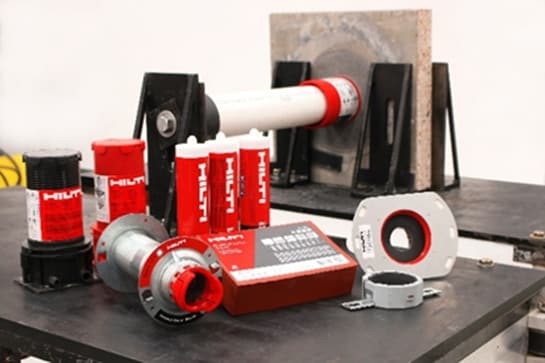
Movement tested Hilti Firestop products
Through intense movement criteria research and testing, Hilti has determined that pre-formed devices, such as the drop-in devices, cast-in devices, and speed sleeves perform significantly better when it comes to movement than traditional sealant systems. Also, pre-formed firestop blocks offer a very good performance in respect to movement. These devices typically exceed the thresholds of the limits set by the standards, and as a result, for firestop systems where movement is critical, pre-formed devices would be recommended. Some firestop devices, for example, allow up to 100% movement in Y direction and the highest performance in Z direction (see below).
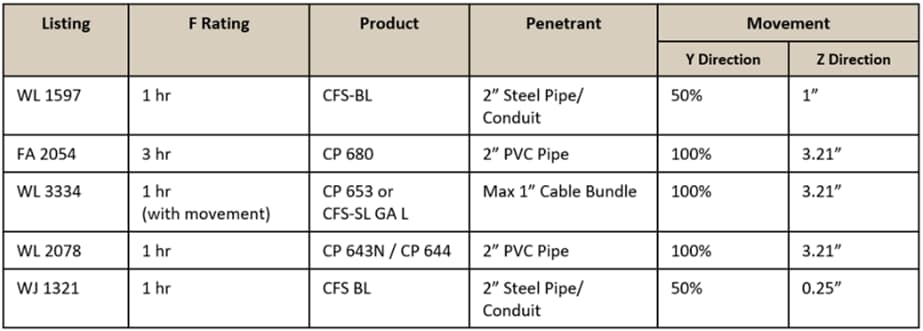
Table of examples of M movement ratings of selected Firestop systems (source: Hilti)
Movement as a new attribute offers additional benefits for engineers
In the absence of current regulatory codes or regulations, it is important to note that M-ratings are currently specification-driven requirements, as they are not yet within the prescriptive code language. Designers, engineers, and architects, however, can prescribe M-ratings in their specifications. They offer firestop manufacturers a way to demonstrate the effectiveness of their firestop products based on exposure to cyclic movement and a UL 1479 fire test evaluation. With data in hand, code authorities, contractors, insurance underwriters, building owners, architects and designers can specify firestop systems that are able to accommodate a certain amount of movement. Additionally, the UL firestop movement certification program allows manufacturers to address design challenges where firestop movement is required via construction specification or other similar requirement(s).
1) Sources: UL.com, case study
2) UL and the UL logo are trademarks of UL LLC
