
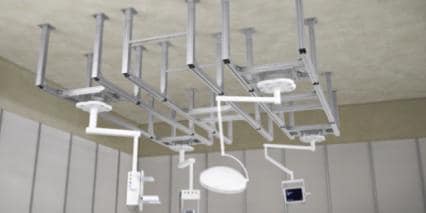
Versatile Yet Steady Hilti overhead grid solution for medical equipment fixation
Optimizing Medical Equipment Support in NZ Healthcare Facilities
Operating theatres are the heart of any hospital, and their long-term functionality is critical for delivering safe and sustainable healthcare. In New Zealand, where seismic resilience and efficient construction are paramount, Hilti’s modular MEP support systems offer a compelling alternative to traditional welded structures. Medical equipment, such as anesthesia pendants, Angio x-ray or microscopes are valuable assets in the room, that require careful and precise planning. However, the selection of the equipment supplier and installation begins in the later stages of the project, after the coordination of services above the ceiling has been finalized. With welded support structures, this leads to significant challenges, rework on-site, and delays. In this article, we will examine various challenges and demonstrate how the Hilti Modular System can help mitigate them.
Challenges in Healthcare Construction
Limited Space and Service Congestion
Medical rooms, particularly operating theatres, are often congested with medical gas lines, electrical conduits, and HVAC systems. This complexity increases the risk of clashes during installation. Traditional welded sub-structures can disrupt critical systems and extend installation timelines. Hilti’s Modular System, featuring an embedded groove design, allows for multidirectional adjustability. This flexibility significantly reduces installation time and complexity, aligning well with New Zealand’s emphasis on efficient, low-disruption construction in live healthcare environments.
Ceiling Mounting in Seismic Zones
Refurbishment projects in New Zealand often involve ribbed slabs or hollow core slabs, which pose challenges for direct grid suspension. Hilti’s solution includes universal MT girder profiles and independent steel frames that reduce slab loads and simplify compliance with NZS 1170.5 seismic design standards. Case studies show up to 40% reduction in frame weight compared to traditional welded systems, an important factor in seismic performance and installation logistics.
Deflection and Vibration Control
Strict deflection limits are essential in healthcare design, particularly in operating theatres and imaging suites. Hilti’s modular system enables 3D structural simulation and stress analysis, helping engineers meet vibration and deflection requirements without resorting to heavy, inflexible steel designs. This approach supports compliance with New Zealand Ministry of Health guidelines and ensures patient safety without compromising design agility.
Sustainability and Environmental Goals
New Zealand’s healthcare infrastructure is increasingly guided by sustainability targets under frameworks like the NZ Green Building Council and MBIE’s Building for Climate Change programme. Hilti’s modular MEP systems contribute to these goals by:
- Reducing material waste through prefabrication and reusability.
- Lowering carbon emissions via lighter structures and faster installation.
- Supporting circular construction practices by enabling easy disassembly and repurposing.
These benefits align with New Zealand’s commitment to carbon neutrality and sustainable building practices in public health environments.
Click here to watch a video explaining this in more detail. If you have any questions, ask them here.
