

Using the qualified systems for your post-installed rebar connections is crucial to the safety of your designs
Post-installed reinforcing bars using injectable polymer grouts are in widespread use in today’s construction. Their use extends from the extension of existing structures to seismic retrofit works.
Examples of these connections appear in all sectors of the construction industry and come in the form of three distinct applications:
- Non-contact lap splices (see Fig. 1a),
- Starter bar (or structural joint) applications (see Fig. 1b), and
- Shear dowel applications (see Fig. 1c).
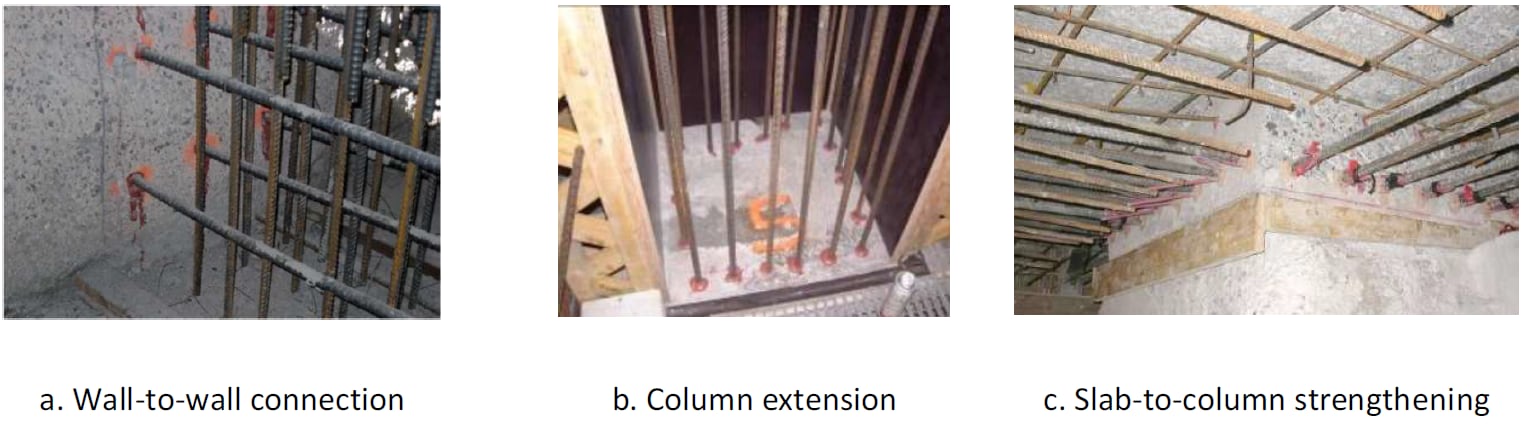
Figure 1: Extension of existing reinforced concrete structural elements using post-installed reinforcing bars.
Post-installed rebar connections are not new to the construction industry, and the solutions used today generally rely on two components epoxy based mortars installed together with a reinforcing bar (see figure 2).
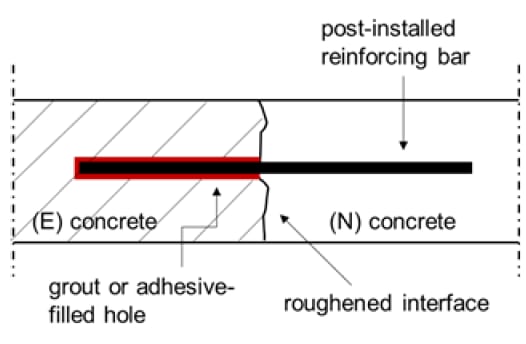
Figure 2: Post-installed rebar concrete-to-concrete connection.
To allow the use of a post-installed reinforcing bar system for the construction of concrete-to-concrete connections, it is first required to verify the compatibility of the post-installed bars with neighbouring cast-in bars. This is done in terms of strength, stiffness, and serviceability.
In recent years, extensive research and testing has been conducted on this topic and guidelines have been developed on how post-installed rebar systems can be designed and qualified to be used with rebar theory [1].
Principles of qualification
The basic principle for the qualification of post-installed rebar systems is verifying that the performance is comparable to cast-in bars. This can be done by looking at the behaviour at the anticipated failure modes in rebar theory;
- Bond failure – defined as extraction of the bars from the concrete without significant concrete breakout,
- and splitting failure – typically characterized as cracking and spalling of the concrete cover.
Bond failure occurs when there is large concrete cover, while splitting failure occurs when the concrete tensile resistance associated with the cover thickness is less than the load capacity corresponding to bond failure, with the assumption that the that concrete cone is suppressed.
See our article on the differences between post-installed anchors and rebar connections to learn more about how the conditions for rebar theory can be met.
In addition to verifying behaviour at relevant failure modes, the performance of the system with respect to installation and installed conditions is required as well. This includes:
- Robustness in different instillation conditions ie. temperature and humidity
- Level of borehole cleaning
- Presence of water
- Corrosive environments
- Drilling method used
- Depth and diameter of the connection
- Viability of the adhesive delivery system
So, the question is, what guidelines can be followed to qualify a post-installed rebar system to be used with rebar theory?
Using a qualified system
Reinforced concrete design standards e.g. NZS 3101, AS 3600, ACI 318, EN 1992-1-1 (Eurocode 2) only talk about cast-in plain and deformed bars, and no guidance is provided how to design post-installed rebars.
We need to confirm that post-installed rebars perform in a similar way to cast-in rebars. Since a layer of polymer grout is present between the rebar and the concrete, the overall behaviour is also dependent on the properties of the polymer grout.
A separate prequalification procedure is needed for this. And following the guidelines of the prequalification, the post-installed rebar design should be done as per the recommendations from the prequalification and corresponding approval documents.
Latest research for Post-installed rebar Systems - EOTA
The guidelines put forward by the European Organisation of Technical Approvals (EOTA) offer a pathway for qualification and design. They are based on the latest research conducted at Institute of Construction Materials (IWB) of the University of Stuttgart. These can be can be found in EAD 330087: Systems for Post-Installed Rebar Connections with Mortar [3].
EAD 330087 [3] was cited into the Official Journal of the European Union (OJEU) in 2018 and provides guidelines for the qualification of post-installed reinforcing bar systems and also stipulates the corresponding design method, this being EN 1992-1-1 [4]. As well, it contains an optional qualification of systems for fire exposure.
The test program for Post-installed Rebar
The testing for qualification as per EAD 330087 [3] can be broken down into 3 parts:
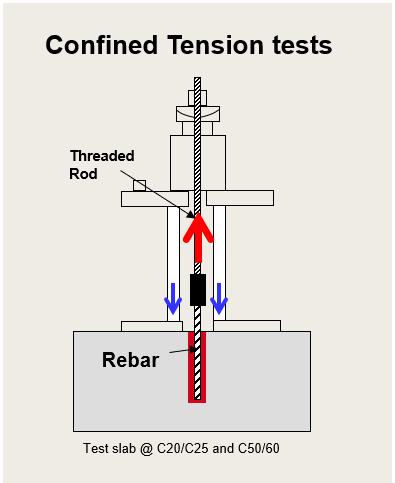
1. A basic tension tests with confined test setup in uncracked concrete at 20MPa and 50MPa across a range of reinforcing bar sizes. This provides the value for the average bond strength of the system.
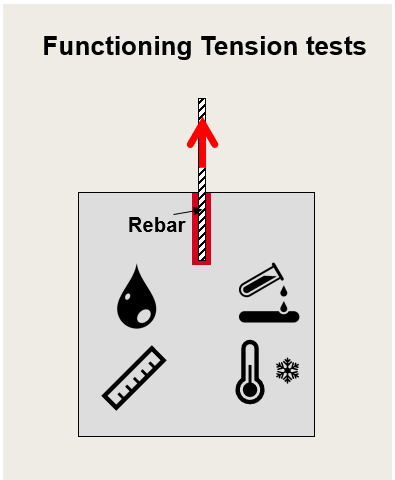
2. A Functioning tension tests to establish the product performance in different environmental and loading conditions which may occur during the service life of the connection. This part also includes tests on the adhesive delivery system and installation method. These tests include:
- Installation with reduced borehole cleaning in dry and water saturated concrete
- Installation at minimum temperature
- Sensitivity to sustained load during freeze-thaw cycles and at elevated temperature
- Sensitivity to installation direction
- Installation at maximum embedment depth
- Corrosion protection of the reinforcing bars
- Durability in alkali and sulfurous environment
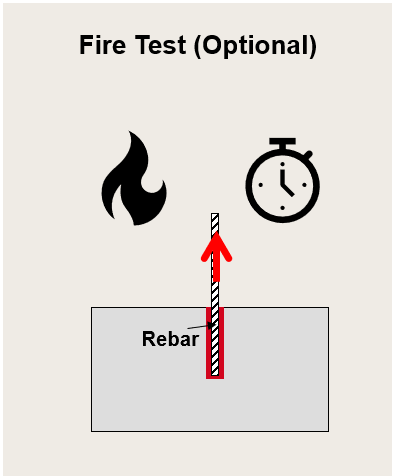
3. Finally, there are optional tests to assess the product for its resistance to fire. These are conducted as confined tension tests applying a sustained axial load with increasing temperature. These tests show the bond strength degradation as a function of temperature.
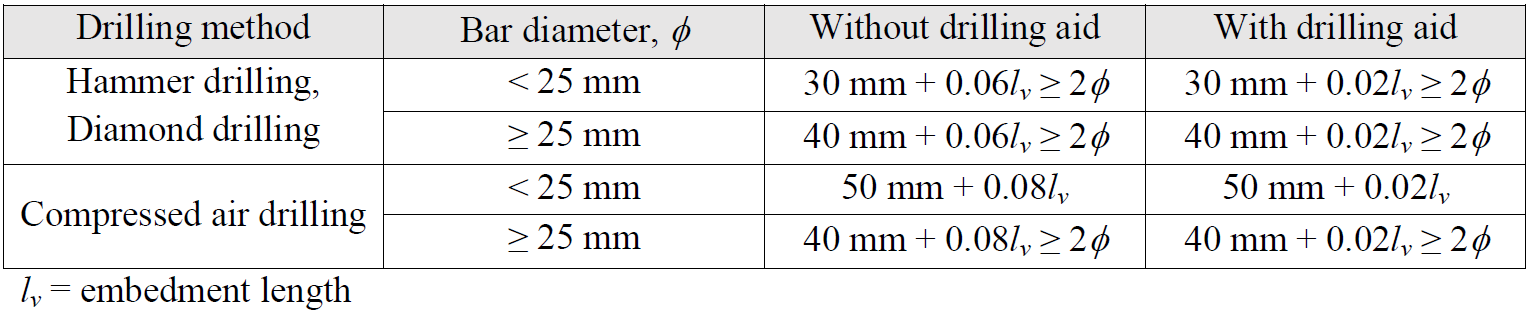
Through the EAD 330087 [3] there are however no tests to verify the minimum spacing to the nearest bar or edge. The minimum edge distance allowed for post-installed reinforcing bar applications is not system-dependent and is a function of the drilling method shown Table 1.
Table 1: Minimum edge distances for post-installed rebar systems according to EAD 330087
Assessing the Minimum required average bond strength
The bond strength check as part of EAD 330087 is obtained from real life data. The average bond strength derived in the basic tension tests is multiplied by a reduction factor derived from the suitability tests and the results are compared with the minimum values, f_bm_req, shown in table 2.
Table 2: Required bond resistances according to EOTA EAD 330087
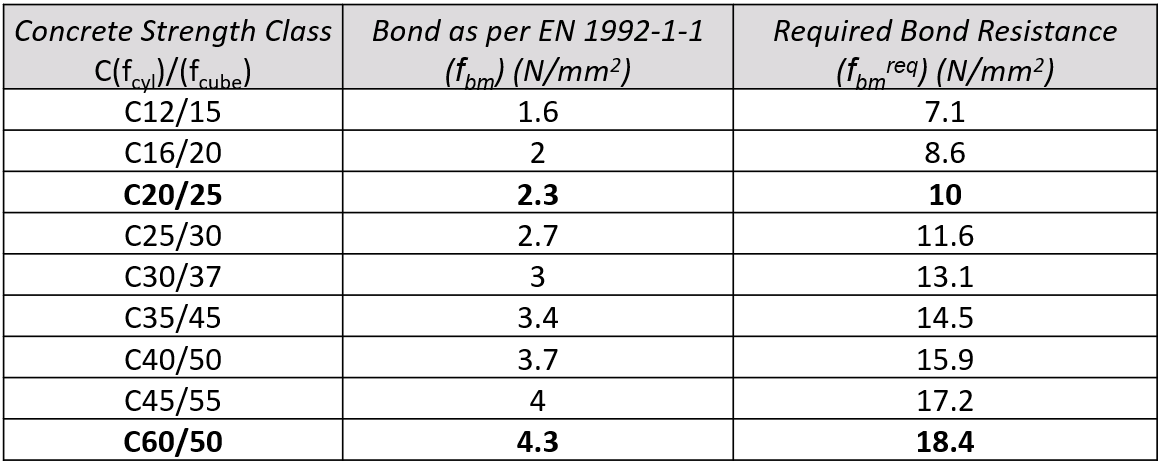
The rationale of the values f_bm_req given in the table are based on research from the University of Stuttgart on the bond strength of cast-in reinforcing bars. According to a database of confined pullout tests in uncracked 20MPa concrete with cast-in reinforcing bars, it was shown that f_bm is equal to approximately 10 N/mm^2.
The research further explains that starting from the desgin bond resistance, f_bd, the average bond resistance f_bm can be derived by multiplying f_bd with the material partial factor γc and the ratio 1/0.75 to calculate the mean value from a given characteristic value assuming a coefficient of variation of 15% at 90% confidence for a high number of samples. The value f_bm_req is also increased by a factor of approximately 2.2 to take into account the effect of cracked concrete [5].
The value f_bm_req can also be calculated as per Model Code 2010 [6].
If the average bond strength from testing is less than the value shown in table 2 the system can still be qualified to be allow for designing anchorages and lap splices. If it has a minimum required value of 7.1 N/mm^2 for all concrete classes, a reduction factor can be included in the ETA approval which results in a reduced design bond strength (F_bd) for the system.
Cracked Concrete Considerations
Finally, there is a consideration for cracked concrete were introduced under the assumption that the behaviour of post-installed systems would exhibit more sensitivity to cracked concrete compared to equivalent cast-in reinforcing bars.
The consideration for rebar installed in longitudinal crack is is outlined in figure 3.
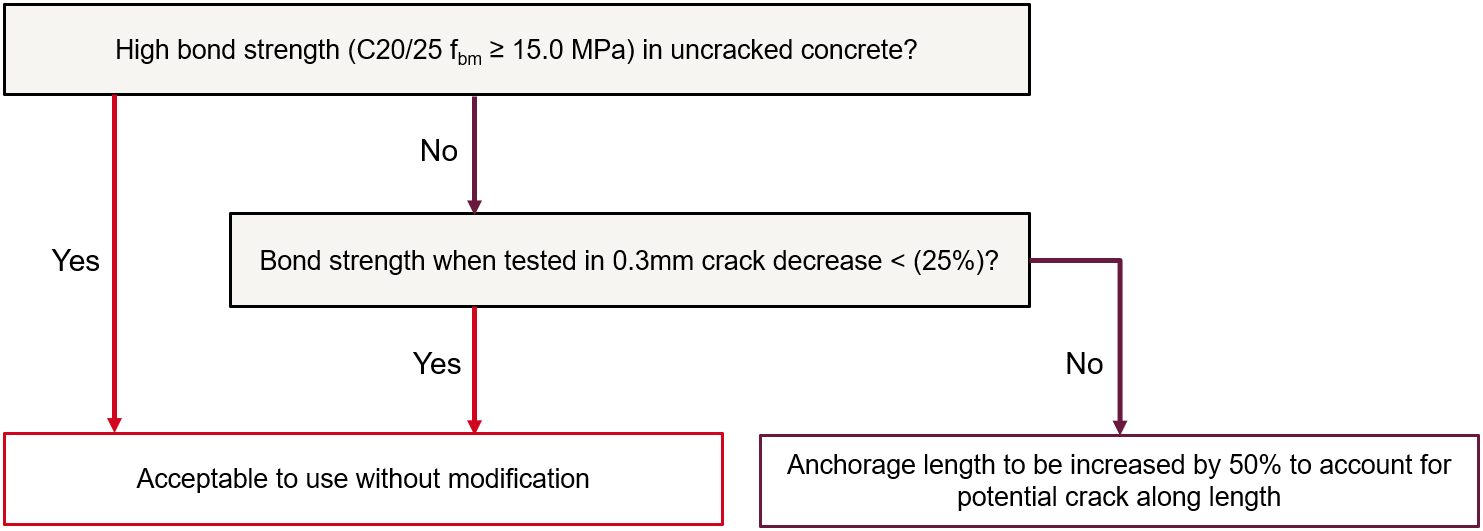
Figure 3: Cracked concrete consideration post-installed rebar system qualification.
What about Seismic?
Currently there is a guideline for seismic qualification of post-installed rebar systems under EAD 331522 [7]. However, this EAD is yet to be cited into the OJEU. Further will be discussed on this when the document is publicly available.
To Conclude
Having your systems for post-installed rebar concrete-to-concrete connections qualified is important so that you can have confidence in the safety of your designs. To be adequately qualified they need to pass a number of checks including compatible load-displacement behaviour, robustness to onsite conditions, and tested installation and delivery systems.
Our local standard, NZS3101 [2], provides no guidelines on how to design or qualify post-installed rebar systems so we need to look elsewhere for a best practice.
Based on current research from the Institute of Construction Materials EAD 330087 [3] can be adopted for use in New Zealand. The test procedure was discussed, and qualified systems will have an ETA approval describing how they are to be designed and installed.
You can view our range of approved solutions here on Hilti Online.
For more details on the content in this article, see our webinar “Designing Post-installed Rebar as a Cast-in Bar”, post a question below or in the Ask section of Ask Hilti, or contact your local Hilti Field Engineer via email on nzengineers@hilti.com.
References
[1] H. Spieth, Tragverhalten und Bemessung von eingemörtelten Bewehrungsstäben (Behaviour and design of post-installed reinforcing bars), University of Stuttgart, 2002.
[2] NZS 3101:1&2:2006 - Concrete Structures Standard, New Zealand Standards.
[3] EOTA EAD 330087: Systems for Post-Installed Rebar Connections with Mortar, 2018.
[4] EN 1992-1-1EN 1992-1-1: Eurocode 2: Design of Concrete Structures – Part 1-1: General rules and rules for buildings, 2004.
[5] Eligehausen, R. Spieth, H., Rationale for the proposed bond strength values, University of Stuttgart, Institute for Construction Materials (not published).
[6] Fib Bulletin 65: Model Code 2010 Final Draft, Volume 1, March 2012.
[7] EOTA EAD 331522: Post-installed rebar with mortar under seismic action, Pending Citation.
