

Concrete filled metal deck floors are getting more and more popular recently in New Zealand, especially in high rise buildings. General structural design of such systems is regulated by AS/NZS 2327:2017 Amd1:2020, however, this standard does not provide guidelines for the design of post-installed anchors in concrete filled metal deck floors.
AS/NZS 2327 defines three different metal deck geometries (Fig. 1): a) Re-entrant trough profile, b) Open trough profile, and c) Clipped-pan profile. All of these geometries are present in the current New Zealand construction practice.
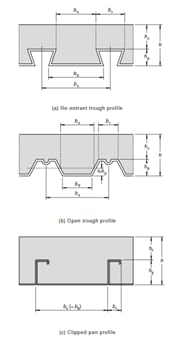
Figure 1: Metal deck geometries as per AS/NZS2327.
Post-installed anchor qualification in concrete filled metal deck
NZS 3101 (through EOTA TR 049) does not regulate the assessment of post-installed anchors in concrete filled metal deck, and consequently, no post-installed anchors are available with ETA (European Technical Assessment) document for seismic applications in concrete filled metal deck.
Furthermore, knowing the behavior of post-installed anchors in concrete during an earthquake, seismic assessment of post-installed anchors in concrete filled metal deck is not possible in laboratory for two reasons:
· Pre-formed cracks in the concrete would not be visible through the metal deck, therefore the location of the drilled holes for anchor testing cannot be determined, therefore anchor installation into crack is not possible from the bottom direction of the slab and
· The crack cycling test is technically not feasible on concrete filled metal deck specimens.
As a result, we need to look for the best practice internationally for assessing the performance of post-installed anchors into concrete filled metal decks.
Best practices for anchors in concrete filled metal deck
In the United States, ICC-ES (International Code Council Evaluation Service) provides guidelines for the assessment of post-installed mechanical anchors in concrete filled metal deck for static loading, in accordance with ICC-ES AC193 “Acceptance Criteria for Mechanical Anchors in Concrete Elements”. The tests are performed in non-cracked concrete. Seismic anchor assessment is not covered by ICC-ES AC193. To fill this gap, ICC-ES has published a memo “Determination of Seismic Values for Anchors installed in the soffit of concrete fill on metal deck floor and roof assemblies under AC193”. This guideline reads: “Currently, the ratios of the cracked-to-uncracked tension values in normal weight concrete are applied to the static tension test values from testing in the concrete fill on metal deck test specimens in accordance with AC193 to derive values for cracked concrete fill on metal deck conditions (static). For anchors installed in the soffit of concrete fill on metal deck floor and roof assemblies that are to be recognized for resisting seismic loads, the following applies: If the tension and shear seismic tests in accordance with AC193, Test Nos. 18 and 19 result in design values that are lower than the static tension and shear design values in cracked concrete from tests in full depth normal-weight concrete specimens, the same reductions shall also be applied to the static tension and shear cracked concrete design values for anchors installed in the soffit of concrete fill on metal deck floor and roof assemblies for seismic applications. This reduction is deemed necessary to account for the influence of seismic loading on the anchor capacity for anchors installed in the soffit of concrete fill on metal deck floor and roof assemblies in the context of anchor design in accordance with ACI 318 Annex D.”
Limits of the ICC-ES Guidelines
ICC-ES AC193 delegates the post-installed anchor assessment testing to ACI 355.2, which document defines only one seismic performance category for post-installed mechanical anchors. This seismic performance category is essentially the equivalent of the ETAG 001, Annex E or EOTA TR 049 seismic performance category C1. Consequently, the ICC-ES memo with the Guideline about seismic assessment of post-installed mechanical anchors in concrete filled metal deck is strictly limited to seismic performance category C1.
Seismic C2 performance category in concrete filled metal deck
There is no assessment procedure published, and no known laboratory testing attempt is available in the international technical literature for the seismic performance of post-installed anchors in concrete filled metal deck. As it was explained above, such tests are challenging since – on one hand – the anchor installation into pre-formed cracks is not possible, and – on the other hand – realistic seismic simulations of cyclically opening and closing cracks is technically not feasible to be performed in a laboratory.
Seismic cracking behaviour of concrete filled metal deck floors is also not available in the international technical literature, therefore, it is not possible to assume how much inferior is the seismic structural performance of concrete filled metal decks in comparison to reinforced concrete flat slabs. It is not realistic to assume that concrete filled metal deck floors remain uncracked in a seismic event when a reinforced concrete flat slab would be assumed to be cracked, which generate multiple open questions in the engineering assumptions of post-installed anchor design for seismic demand in concrete filled metal deck floors.
Lower flutes of concrete filled metal deck floors of re-entrant trough profile metal decks or open trough profile metal decks can be especially sensitive to horizontal loads generated by earthquake events. The general shear stiffness of such lower flutes is unknown that makes challenging to assume the shear performance of post-installed anchors under a design level earthquake event. The concrete edge distances can be very small in such lower flutes (much smaller than that would be allowed for normal reinforced concrete), and the confining effect of the very thin steel sheets of the metal decks is experimentally not explored for such seismic applications. In the lack of experimental observations and product assessment, the seismic design of post-installed anchors for seismic performance category C2 is highly stipulative and cannot be supported by any international document or standard.
Learn more about what seismic C1 and C2 mean for post-installed anchor design in New Zealand in our related article.
