
What does cracked concrete mean in anchor design? Let’s clarify this simply
The invention of reinforced concrete is attributed to Joseph Monier, French gardener. He opened his workshop in 1849, where he started to manufacture hollow artificial boulders from his invention: ferro-cement (French: "ciment et fer"). In 1867 he exhibited his ideas at the second Paris International Exhibition (Exposition Universelle) and he applied for his first patent of this new material. In 1879, Prussian engineer A. G. Wayss bought the German rights to Monier's patents and started the first commercial use for reinforced concrete in his firm Wayss & Freytag. With the leadership of the company’s chief engineer E. Mörsch they understood the basic principles of reinforced concrete, namely that the steel absorbs all tension stresses and the concrete only provides compression resistance. The true reinforced concrete theory was born.
A cracked tension zone is always assumed in general reinforced-concrete construction design, and this condition alone does not represent a safety hazard (although there may be some concerns regarding durability). But in the process of designing a steel anchor plate connection, this subject is clearly of greater importance, since cracks in an anchoring base material not only impair the distribution of stress resulting from loaded anchors, but also lead to the serious malfunctioning of anchors that are not suitable for this condition.
As an engineer, you are the one in charge of assuming in your design strategy whether or not the concrete is cracked in the fixing area, as well as selecting and designing the anchor plate connection accordingly. However, you must be aware that the results of this process can vary significantly depending on the initial assumption and the anchor system selected.
Generally, one has to assume that the concrete is cracked, unless proven otherwise (such as by conducting a thorough stress analysis or a documented visual inspection of cracks).
To make a well-founded decision, you might be interested in the basics of fastening into cracked concrete, which are covered in this article. The focus of this article is on static conditions; we will cover seismic conditions in a this article. All references are included at the end of the page.
How cracked will the concrete be?
Concrete has a low tensile strength, so cracks are also expected in service conditions in flexural or tension components. Experience shows that crack widths resulting from primarily quasi-static loads (dead loads plus a fraction of live load) do not exceed the value of w95% ~ 0.3 mm to 0.4 mm. Wider cracks are to be expected under maximum permissible service loads, which reach w95%~0.5 mm to 0.6 mm [2],[3],[4].
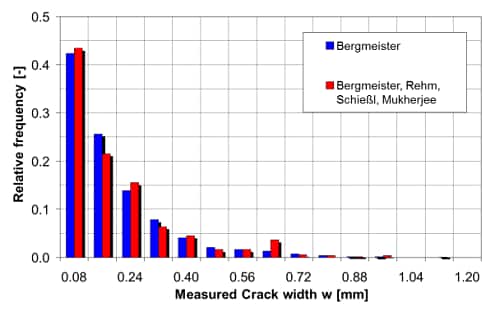
Relative frequency of measured crack width
under maximum service loads ([2],[3],[4])
Cracks depend on both internal and external forces
Cracks form in reinforced concrete members not only due to the action of forces (transferred from the fixing or other elements in the structure) but also earlier as a result of the hardening process (including shrinkage). Additionally, stresses can be result of constraint forces due to differences in temperature, hindered deformation or foundation settlement which, in turn, might cause cracking.
If concrete is tensioned, cracks most likely will intersect the anchor
It has been observed that when cracks form in a concrete member, it is highly likely that they will intersect the anchor location directly or tangentially [1]. This occurs because higher tensile stresses exist around the anchor as a result of the hoop stresses associated with loading of the anchor and the stress concentration caused by the presence of the anchor hole (notch effect).
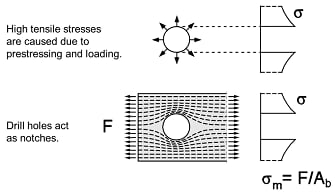
The likelihood of seeing cracks form in relation to the anchor position is very high, due to the stress concentration and discontinuity caused by the fixing itself.
The higher stress field associated with cracks reduces the load
In non-cracked concrete, a tension-loaded anchor generates a rotationally symmetric stress pattern around the anchor [1]. If the anchor is located in cracks, the tensile stresses can no longer be transferred across the crack plane and are not rotationally distributed (disturbance of the rotational stress field). This reduces the failure load in the case of concrete cone failure.
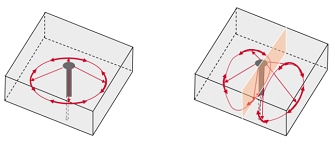
Distribution of forces in the anchorage
zone in uncracked and cracked concrete [1]
An anchor designed for non-cracked concrete can exhibit uncontrolled slip when loaded in tensioned concrete
The effect of cracking is not only on the peak load of the fixing. In fact, the load displacement behaviour can also vary significantly according to the anchor's capability to respond to the notch opening. For example, torque-controlled expansion anchors that are not suitable for applications in cracked concrete can exhibit uncontrolled slip when loaded in tension in cracks. Uncontrolled displacements causing unpredictable deflections are a risk for both Serviceability Limit State (SLS) and Ultimate Limit State (ULS), especially for some applications such as free-standing structures, cantilevers and rigid beam connections.
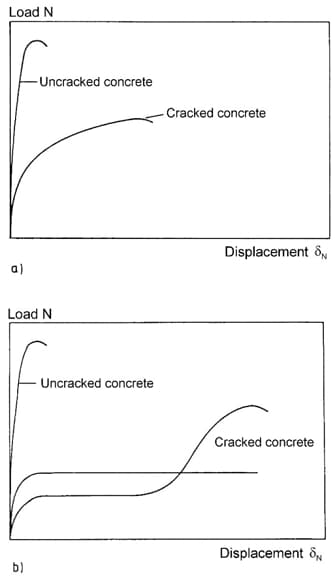
Schematic load displacement curves of torque-controlled anchors tested [1] in tension in cracked and non-cracked concrete
a) Anchors suitable for use in cracked concrete
b) Anchors not suitable for use in cracked concrete
To conclude
In general, cracks in concrete are expected, and the probable location of the cracks can be easily predicted in the anchor position, implying a reduction of the load capacity or higher deformations. We recommend that you always consider the concrete as cracked in your design, unless dealing with applications where it is clear that the concrete will never be tensioned, such as light fastening on pre-stressed concrete elements (to be proven, in any case). Otherwise, anchors qualified for use in tensioned concrete should be used to ensure safety through a proper design, while solutions for which the performance has not been assessed in this condition cannot guarantee adequate reliability.
If you want to know more about which solutions are more adequate in cracked concrete and how to execute your designs accordingly, just leave a comment here.
References
[1] Eligehausen R.; Mallee, R.; Silva, J.F. (2006): Anchorage in concrete construction, Ernst & Sohn, Berlin 2006
[2] Schiessl, P. (1986): Crack influence of the durability of reinforced and prestressed concrete components. Schriftenreihe des Deutschen Ausschuss für Stahlbeton, No. 370, Ernst & Sohn, Berlin 1986 (in German)
[3] Bergmeister, K. (1988): Stochastic in fixing technology based on realistic influenced parameters, Doctor Thesis, University of Innsbruck, 1988 (in German)
[4] Eligehausen, R.; Bozenhardt, A. (1989): Crack widths as measured in actual structures and conclusions for the testing of fastening elements. Report No. 1/42-89/9, Institute of Construction Materials, University of Stuttgart, August 1989
