
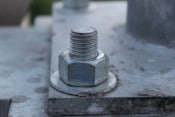
Stud anchors are widely used. Learn more about how they work and drive safer specifications
Concrete anchor fasteners: a commonly neglected construction detail in the design phase. It represents a small part of a project in terms of the volumes and cost, but it can have a significant impact on the safety of the work overall.
Anchor systems however are not simply a "detail". Anchor systems have an important role in completing steel to concrete connections. As well anchor systems are often presented with some challenging conditions;
- It is not rare that the forces to be transmitted from the fixing to the base material are the maximum you see in the whole structure;
- The geometry is often not favourable, offering limited space and short edge distances, making it even harder to find the right anchor configuration.
There are many anchor systems available for the steel to concrete application. Let's look at one of the most widespread anchor technologies: the stud anchor.
Stud anchors: a well-known fastening technology
The stud anchor is made up of a threaded bolt with a cone at the end, an expansion sleeve, a washer and a nut for tightening (as shown in the figure, for the stud anchor HST3).

To understand the working principle it is first useful to look at how the anchor itself is set. After drilling and cleaning the bore hole, the stud is inserted into the hole by manual hammering or using a setting tool. The anchor plate is then positioned, and torque is applied to the nut to the value defined by the manufacturer for the given anchor type and diameter, completing the installation.
The working principle for stud type anchors is friction. The torque causes the cone to be drawn into the expansion sleeve, which then deforms and expands against the concrete. This allows tensile loading applied to the anchor dowel to be transferred to the concrete base material through to the radial pressure generated by the expansion, and the friction between the sleeve and the concrete.
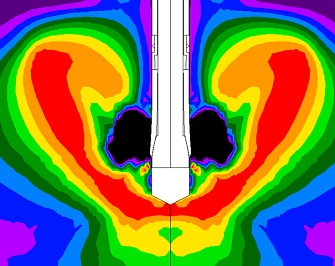
Stress contour due to the expansion of the sleeve
Not all stud anchors are the same, especially in cracked concrete and seismic conditions.
Under cracked-concrete and seismic conditions, expansion fasteners without a specially designed sleeve may lose pretension and slip out. This will happen especially when cracks open and close throughout the service life of the structure or during a seismic event. If not properly designed for, it can result in uncontrolled behaviour and failure of the fixture.
How can you deal with this? Consider only using anchor systems that have been tested and approved by a qualification process for your application requirements. Otherwise, you cannot predict the real behaviour in the design conditions.
This means choosing only cracked-concrete approved anchors, unless you can ensure that the concrete will never be in tension throughout the lifetime of the structure. As well if your anchor will be subjected to cyclic seismic loading then you will need to use a seismic qualified system.
Simply refer to the European Technical Assessment document (ETA) of the system you intend to use for your application (click here to go to the HST3 product page, our own high performance stud anchor approved for cracked concrete and seismic loading conditions).
Once you have selected your anchor then you need to complete your design accordingly using a reliable software such as PROFIS Engineering.
Pay attention to the installation torque
When it comes to anchoring in concrete, applying the right torque is critical for ensuring that the cone is pulled into the sleeve and is stopped in the right position to generate the required expansion forces. If the correct torque is not applied, then there are different consequences depending on if too much or not enough is applied.
Under-torqueing results in the cone being in the incorrect position i.e. it is not drawn far enough into the expansion sleeve to achieve the specified holding values. Only once the external load is applied does the anchor shift and the cone gets pulled in the right direction. In other words, the anchor was loose and relied on external loading to set it securely in place. The maximum load or resistance values can be achieved, but only once the anchor has been pulled slightly away from the intended position. The result is an installation with excessive displacement.
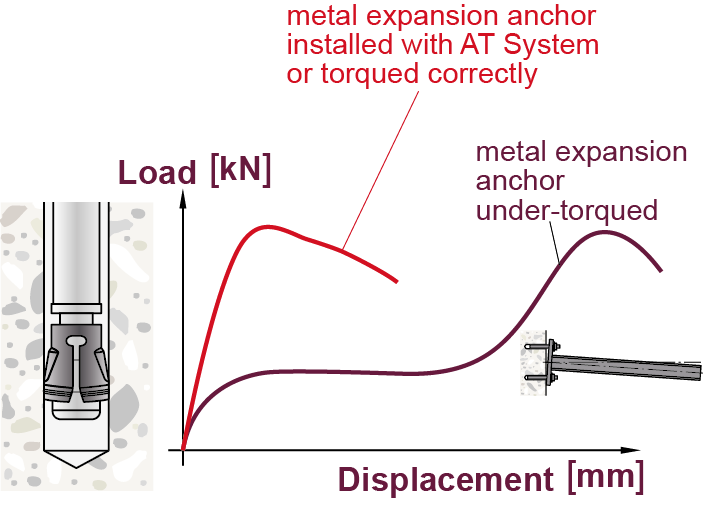
Over-torqueing instead results in the cone being pulled too far into the expansion sleeve, resulting in various concerns depending if the anchor is installed close to the edge or in the middle of the slab. When an over-torqued anchor is placed close to the edge, the extra expansion force generated could cause the concrete to break, even before loading the fixing.
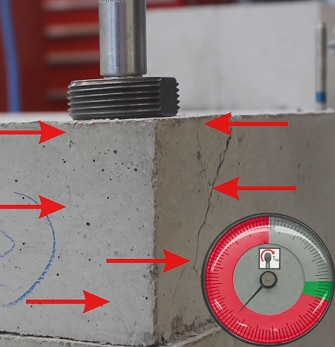
Over-torqueing close to the edge might result in the concrete breaking out
When an over-torqued anchor is away from the edge of the slab, the steel bolt can be damaged – or even broken apart – by this torsional moment. The result is a drop in the steel capacity under tension, shear, or combined tension and shear loadings.

Although the installation torque is printed on the box, many installers are still not aware of the risk of incorrect torqueing. To be on the safe side, always specify the installation torque in your project documents and shop drawings.
You can also specify the AT tool to ensure the correct tightening. The AT tool will also record that the correct torque has been applied to a set of anchors and can be used to generate a report for inspection.
Application tips
Stud anchors are generally well suited for use used in both non-structural and structural applications where high performance with low embedment (150mm or less) is required. They are often preferred over adhesive anchors as they can be loaded immediately after installation and require no curing time. Adhesive anchors on the other hand can be designed with variable embedment allowing much higher embedment and capacities.
